RFQs require too much manual prep
Drawings, specs, quantities, due dates, and customer notes have to be collected and interpreted before quoting.
Manufacturers and fabrication shops often run on quoting pressure, shop-floor updates, purchase needs, and customer timelines. Auvant can build focused workflow software that connects the office and production floor without overcomplicating the operation.
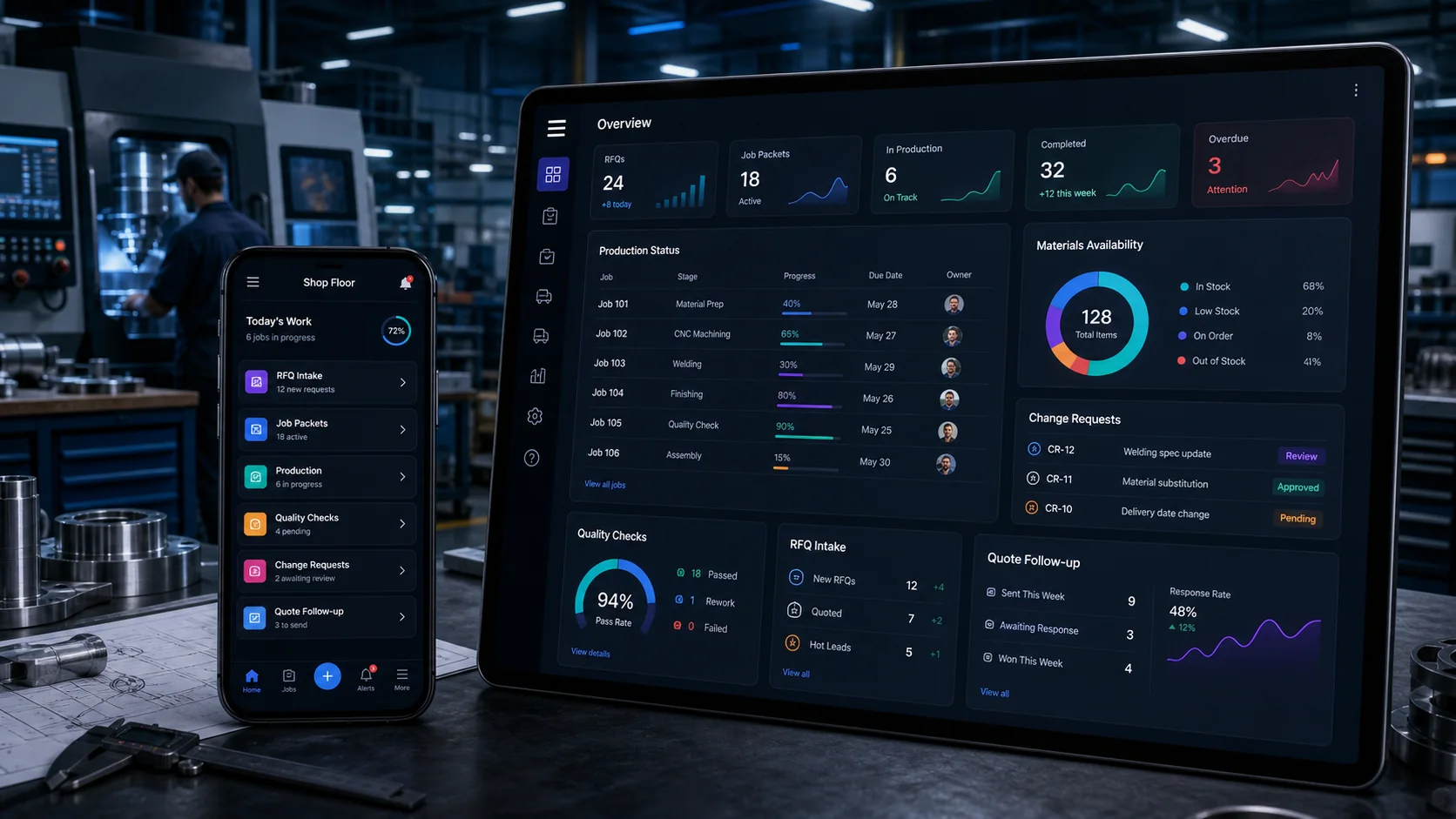
Auvant looks for repeatable work that is valuable enough to improve, but controlled enough to pilot safely.
Drawings, specs, quantities, due dates, and customer notes have to be collected and interpreted before quoting.
Sales, production, purchasing, and shipping each hold part of the truth.
Photos, defects, rework, and inspection results may not flow into customer or management reporting.
Material needs, shortages, and vendor follow-up are found too late in the production timeline.
Information is copied, chased, summarized, or remembered across disconnected tools.
Collect specs, files, due dates, materials, tolerances, and missing questions for estimator review.
Information is copied, chased, summarized, or remembered across disconnected tools.
Track jobs by stage, blocker, owner, target date, and customer impact.
Information is copied, chased, summarized, or remembered across disconnected tools.
Capture photos, notes, root cause, rework status, and approval history.
Information is copied, chased, summarized, or remembered across disconnected tools.
Turn job needs into reviewed requests, vendor follow-up, and expected delivery updates.
The useful pattern is not one generic chatbot. It is a small set of agents with narrow jobs, clear inputs, and human review where risk matters.
Try the AI Agent Lab →Summarizes customer requests, extracts key specs, and flags missing quote information.
Highlights stalled jobs, missing updates, and upcoming due-date risk.
Turns inspection notes into a concise issue record for review.
Prepares vendor follow-ups and material-risk summaries for a buyer.
New requests, files, missing data, estimator assignment, and quote status.
Jobs by stage, blockers, due dates, quality notes, and customer urgency.
Photos, defect categories, resolution status, approvals, and recurring patterns.
Purchase requests, supplier follow-up, shortages, and expected receipt dates.
Choose RFQs, custom orders, rework, or material follow-up.
Identify who needs what information at each stage.
Show managers and team leads the exact visibility they would get.
Use AI to prepare summaries and flags while staff control commitments.
Auvant positions AI as an operational assistant, not a black box that makes important decisions without people.
AI summaries must be traceable back to the source request, drawing, or note.
Scheduling, pricing, quality acceptance, and commitments stay human-approved.
Shop, office, customer service, and leadership can each see the right level of detail.
A careful pilot can handle uploaded files and notes, but engineering interpretation and final quoting stay human-reviewed.
Usually no. It can fill the operational gaps around RFQs, status, quality notes, and follow-up.
Yes. Smaller teams often benefit because the owner needs visibility without adding more admin burden.
Start with a focused automation audit or a short pilot discussion. The goal is to find one workflow worth improving, prove it, then expand only where it pays off.